

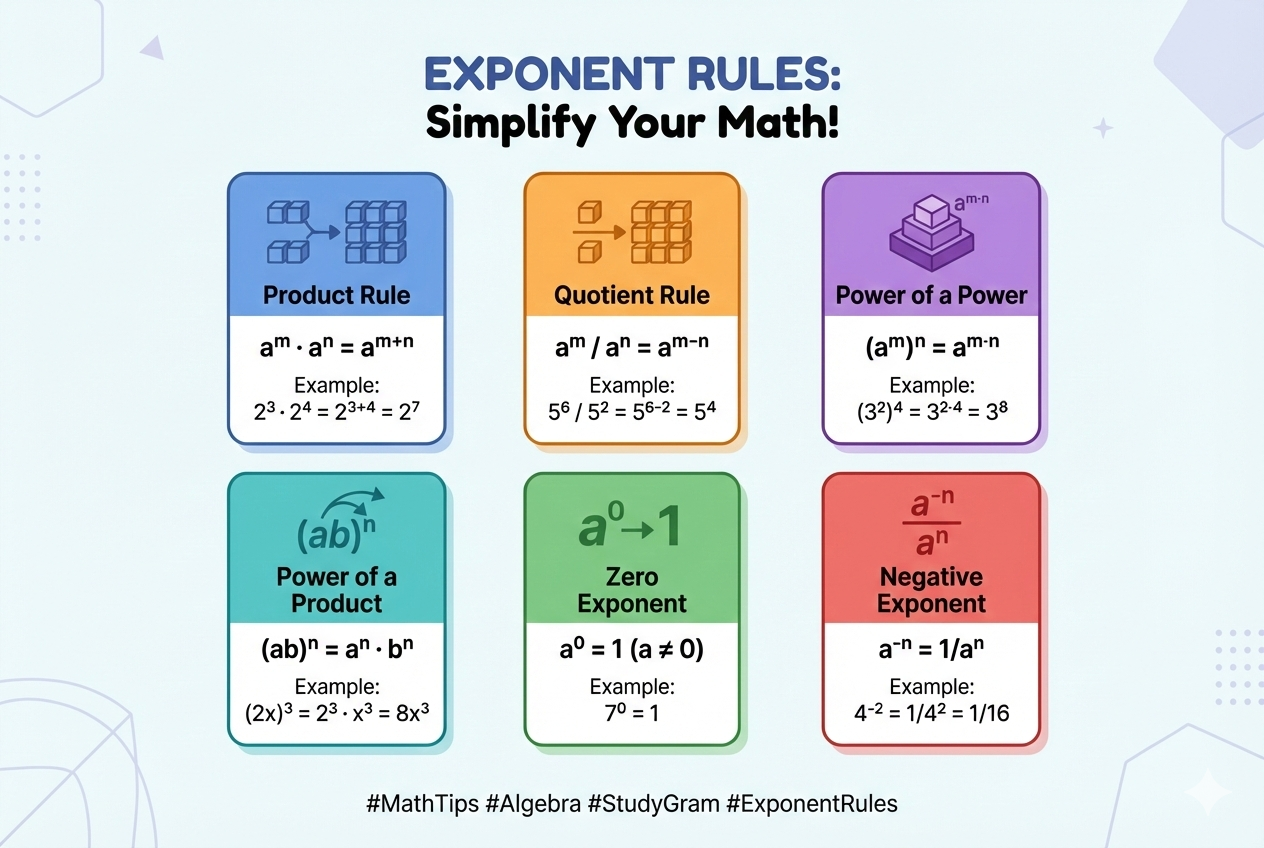
Ever felt overwhelmed by numbers with tiny floating companions, like 5353 or x2x2? These companions are exponents, and they’re not there to complicate your life—they’re powerful tools for simplifying it. Whether calculating medication dosages, understanding exponential bacterial growth, or interpreting research data, a solid grasp of exponent rules is a practical, transferable skill. Let’s demystify the most essential rules with clear examples, so you can handle them with confidence.
What Are Exponents?
An exponent (the small, raised number) tells you how many times to multiply the base (the larger number) by itself.
Example: 5353 means 5×5×5=1255×5×5=125. It’s a shorthand for repeated multiplication.
The Essential Rules to Master
1. The Product Rule
When multiplying the same base, add the exponents.
am×an=am+nam×an=am+n
Why it matters: It simplifies calculations. Instead of calculating 24×2224×22 as (2×2×2×2)×(2×2)(2×2×2×2)×(2×2), simply add: 24+2=26=6424+2=26=64.
2. The Quotient Rule
When dividing the same base, subtract the exponents.
am÷an=am−nam÷an=am−n
Illustration: 5754=57−4=53=1255457=57−4=53=125. This is crucial for simplifying formulas, like those in pharmacokinetics.
3. The Power Rule
When raising a power to another power, multiply the exponents.
(am)n=am×n(am)n=am×n
Example: (32)4=32×4=38(32)4=32×4=38. This is key for working with complex equations.
4. The Zero Exponent Rule
Any non-zero base raised to the power of zero equals 1.
a0=1a0=1
Application: This rule ensures consistency in mathematical models and is frequently encountered in scientific formulas.
5. Negative Exponents
A negative exponent means “take the reciprocal of the base” and then apply the positive exponent.
a−n=1ana−n=an1
For instance: 4−2=142=1164−2=421=161. This rule is essential for manipulating formulas in chemistry and physics.
Why This Matters for You
In nursing and healthcare sciences, you’re not just learning math for an exam. You’re building a toolkit. Exponential functions model population growth, radioactive decay in diagnostics, and the spread of infection. Understanding these rules allows you to confidently interpret research, validate calculations, and apply formulas accurately in clinical scenarios.
Mastering Concepts While Managing Your Load
Nursing programs are intensely demanding. Between clinical rotations, labs, and a mountain of coursework, finding the time to solidify foundational math concepts can feel impossible. If you’re struggling to apply these rules to complex dosage calculation problems or scientific assignments, know that seeking support is a sign of professionalism, not a weakness.
Let USWritersPro Be Your Academic Partner. Our team of experts, including professionals with strong backgrounds in the sciences, can provide the targeted assistance you need. We help nursing students by:
Offering clear, step-by-step explanations of challenging concepts.
Providing tutoring and model solutions for math-based assignments.
Assisting with research and data analysis for papers, freeing you to focus on patient-care skills.
Don’t let academic pressure compromise your learning or your grades. A clear understanding of foundational concepts is an investment in your future as a competent, confident healthcare professional.
Need help applying exponent rules to a real assignment or mastering other mathematics and scientific concepts?
Contact USWritersPro Today for personalized, professional academic support designed for the unique challenges of nursing education.