

You’ve read the prompt. You’ve done the reading. Now you’re staring at a blank text box, wondering how to turn your scattered thoughts into a post that earns full marks. The clock is ticking, and “I agree with the author” is starting to look tempting.
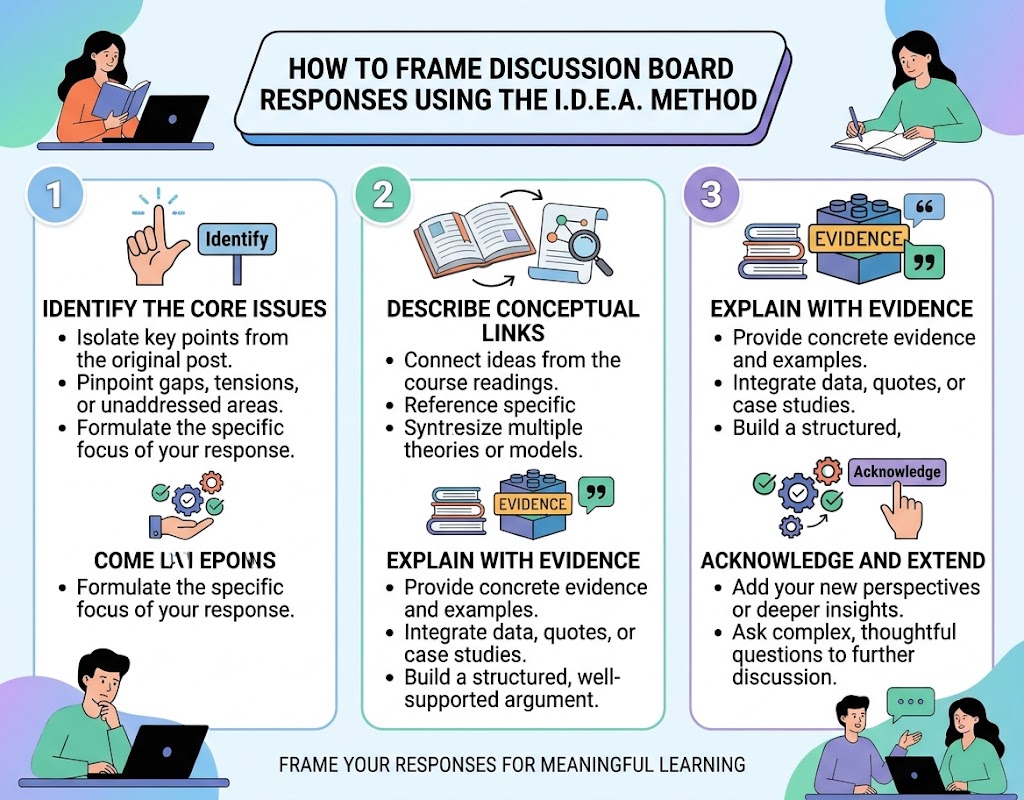
Here’s the fix: The I.D.E.A. Method. It’s a simple, repeatable framework that transforms vague reactions into substantive, high-scoring discussion board responses. Best of all, it takes less than ten minutes once you understand the structure.
What Is the I.D.E.A. Method?
I.D.E.A. stands for Identify, Develop, Evidence, and Ask. Each component serves a distinct purpose in crafting a response that demonstrates comprehension, critical thinking, and engagement—the three criteria most professors use to grade discussion boards.
Let’s break it down.
I — Identify the Core Claim
Start by explicitly naming the central argument or observation from the prompt (or from a classmate’s post, if you’re replying).
Why it matters: Professors want to see that you understood the prompt and can distill the main point. Vague openings signal vague thinking.
Example:
“The author argues that standardized testing fails to capture creative problem-solving skills.”
Notice the difference between that and: “This article was about testing.” The first demonstrates comprehension. The second merely acknowledges existence.
D — Develop Your Position
Next, articulate your perspective. Do you agree, disagree, or see nuance? State it clearly.
Why it matters: Discussion boards aren’t just summaries—they’re opportunities to demonstrate your own analysis.
Example:
“I largely agree, but I’d argue that the problem isn’t testing itself—it’s the narrowness of what standardized tests measure.”
This shows you’ve moved beyond agreement into critical engagement.
E — Evidence and Examples
This is the heart of your response. Support your position with evidence from the course material, real-world examples, or scholarly sources.
Why it matters: Claims without evidence are opinions. Claims with evidence are arguments.
Example:
“A 2022 study in Educational Psychology Review found that project-based assessments better predicted college success than SAT scores. Similarly, Finland’s education system relies less on standardized testing and consistently produces strong outcomes.”
Pro Tip: Cite sources in-text (author, year) even in discussion boards. It signals academic rigor.
A — Ask a Question
End your response with a question that invites further discussion. This serves two purposes: it demonstrates engagement, and it positions you as a conversation leader.
Why it matters: Questions generate replies. Replies generate engagement. Engagement generates points.
Example:
“If standardized tests aren’t the answer, what would a more equitable assessment system look like? Could we combine project-based evaluations with traditional metrics?”
Putting It All Together: A Complete Example
Let’s see the I.D.E.A. Method in action:
Prompt: Does social media harm adolescent mental health?
Response:
The author argues that social media is a primary driver of declining mental health among adolescents. I largely agree, but I believe the relationship is more nuanced than a simple cause-and-effect. Rather than social media itself, the type of use—passive scrolling versus active engagement—may be the key factor. Research from the Journal of Adolescent Health (2023) found that passive consumption correlated with increased anxiety, while interactive use showed neutral or positive effects. This suggests that blanket restrictions may be less effective than teaching digital literacy. How might schools implement such education without overburdening teachers?
— Identify. Develop. Evidence. Ask.
That response is concise, substantive, and high-scoring—and it took less time to write than a rambling “I agree” paragraph.
Common Mistakes to Avoid
Skipping the evidence. Without it, you’re just opinion-sharing.
Forgetting the question. The “A” matters. It’s what separates a good post from a great one.
Writing too much. A 150–200 word response following I.D.E.A. is more effective than a 500-word ramble.
When to Seek Support
If you’re struggling to structure discussion board responses, cite sources correctly, or manage your online course workload, USWritersPro can help. Our tutors provide coaching on academic writing, discussion board strategies, and citation formatting.
Ready to turn discussion boards into easy points?
Contact USWritersPro Today for expert academic support. One method. Four steps. Better grades—starting now.